Germany’s Digital Future Needs Electricians Too: What Indian Jobseekers Should Know
Germany’s digital future needs people who can connect a building, maintain a production line and keep industrial equipment running. If your experience is practical and technical, do not assume that the opportunities are only for software developers. But start with a specific occupation—not a shortage headline.
Published

What the IW study found
The German Economic Institute, known as IW, published Wer baut die Zukunft?—meaning Who is building the future?—on 19 October 2026. It examines shortages linked to infrastructure, the energy transition and digitalisation.
After counting overlapping occupations only once, IW estimates an average gap of 148,047 qualified workers between July 2025 and June 2026. That is approximately 44% of the estimated nationwide skills gap.
About 70% of the gap across these groups concerns roles requiring completed vocational training. Building electrical installation, heating and air-conditioning technology, industrial electrical work and machinery maintenance are prominent areas.
The study was commissioned and funded by The BlackRock Foundation. IW states that it produced the research independently.
Digitalisation depends on physical systems
Software needs equipment to run on. Automated factories, communication networks and connected buildings need electrical connections, controls, machinery and maintenance.
In the report’s digitalisation category, four occupational groups account for around 73% of the estimated gap. Their work also supports energy-transition projects, creating competition for related skills.
- Building electrical installation: installing and connecting electrical systems.
- Industrial electrical engineering: operating and maintaining industrial electrical equipment.
- Mechanical and plant engineering: supporting machinery and production systems.
- Mechatronics: combining mechanical, electrical and control systems.
Globe Pravasi perspective: search by the work you can do
A familiar industry label can hide adjacent opportunities. If you have worked in manufacturing, ask which of your skills match employers in industrial services, equipment, energy or infrastructure.
Describe your actual responsibilities: installation, fault finding, preventive maintenance, commissioning, controls or project coordination. Then compare them with the tasks in a specific vacancy.
This is our practical interpretation, not an employment outcome measured by IW. Moving into a related sector can require additional training, different safety procedures or experience you do not yet have.
An Indian qualification is not an automatic match
An ITI qualification, diploma or engineering degree should not automatically be treated as equivalent to the German qualification in a job advertisement.
An electrical engineering graduate and an industrial electrician may share technical knowledge, but employers can expect different practical training, experience and responsibilities.
Identify the German reference occupation that best matches your training and work. Then check recognition requirements, the job’s duties and the requirements of the immigration route relevant to you. Recognition means the formal assessment of how a foreign qualification compares with a German one.
- What is the German name of the occupation matching my experience?
- What qualification and recognition does this particular role require?
- What German-language ability is needed for everyday work and safety instructions?
- Does this employer recruit internationally, and what support does it actually provide?
Ausbildung deserves a careful look
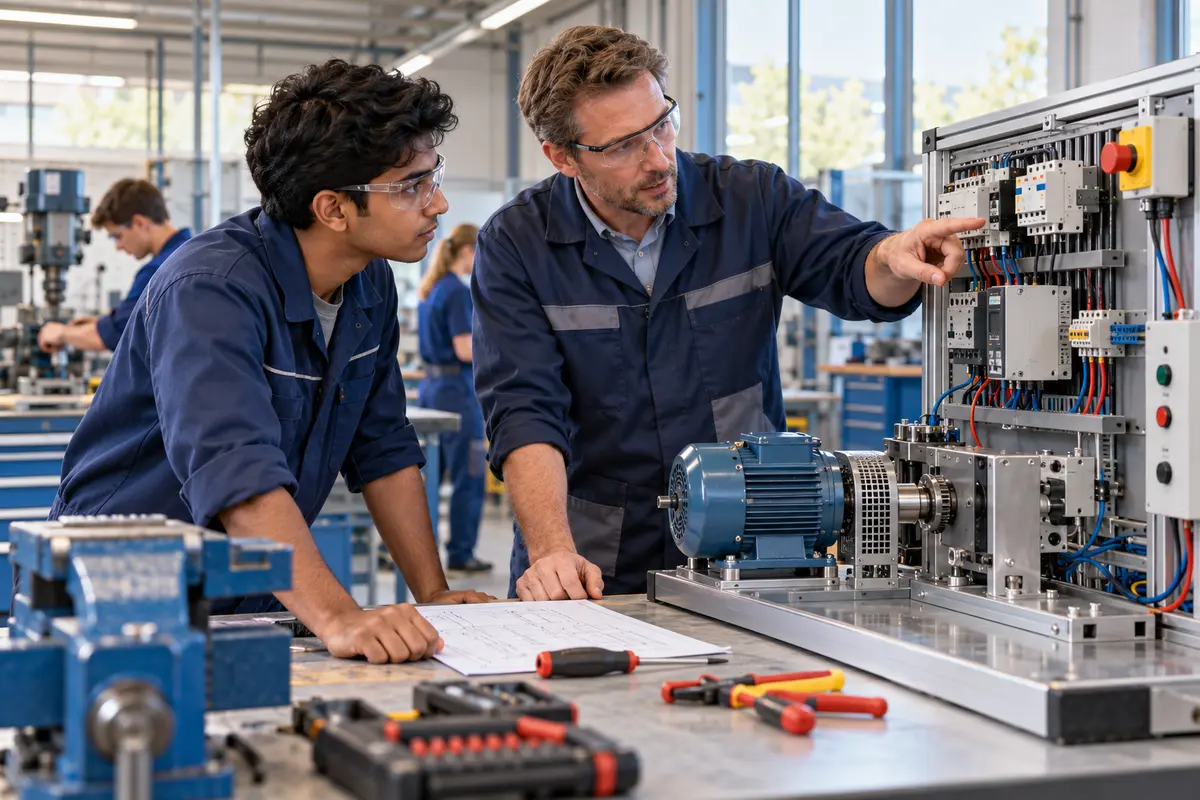
Ausbildung means vocational training. For someone considering a new technical career, the report is a reason to investigate programmes—not a reason to commit before understanding them.
Compare the daily tasks, training structure, language expectations, location, training pay and living costs. Ask what happens at the workplace and what you will study at vocational school.
Applying for training and applying as an already qualified worker are different starting points. An experienced technician should first investigate how existing training and experience can be assessed, rather than assume that starting again is necessary.
Experienced engineers: examine transferable skills
If you are an experienced engineer, look beyond your current sector while staying realistic about the role. Project coordination, installation experience, maintenance knowledge and familiarity with industrial systems can help you identify relevant employers.
Make the connection explicit in an application. Explain which system you worked on, what you were responsible for and how that experience relates to the advertised work.
A shortage of vocationally qualified technicians does not automatically imply the same demand for every engineering specialisation or management role.
What the 148,000 figure does not show
This is a calculated mismatch between vacancies and suitably qualified unemployed people. It is not a live vacancy list, a count of jobs reserved for international applicants or evidence that those employers provide immigration support.
The period covered ends in June 2026. Check current vacancies before making a decision. Because the occupational categories overlap, their separate shortage totals should not be added together.
The study does not provide an individual probability of securing a job, a visa, qualification recognition or an Ausbildung place.
A practical next step
Choose one target occupation. Read several current vacancies in different regions and note the recurring tasks, qualifications and German requirements. Compare these with your own evidence of training and experience.
If important requirements are unclear, contact the employer or the responsible recognition advice service before paying an intermediary or making relocation plans.
Germany’s infrastructure and digital ambitions depend on skilled people who can install, connect, operate and maintain equipment. For Indian jobseekers, the useful opportunity starts where those needs match a specific professional profile.
Sources
Research the occupation, qualification match, German requirements and employer readiness. A national skills gap is a starting point for a focused search, not a job offer.
Explore our Germany job-search guide →General career information and editorial interpretation as of 23 October 2026, not individual immigration or recognition advice. Shortage estimates do not guarantee employment. Illustrations depict fictional workplaces and people.
Join the conversation
Loading likes and comments…